Manufacturing Know-How
Product Development·12 MIN READ·14 May 2026
How can I estimate the price of a part before sending a request for a quote?
CH
Chainly
The price of a manufactured part isn’t magic—it consists of several clearly definable components, and for each technology, it is driven by a different parameter. Once you understand these, you’ll be able to make inquiries with realistic expectations, spot inflated quotes, and know which design changes will lower the price the most. We’ll go over the general breakdown of pricing and then look at specific pricing structures for CNC machining, sheet metal fabrication, and 3D printing.
01
The Anatomy of Price: What Every Quote Is Made Of
Regardless of the technology, the unit price consists of four components: materials, machine time (machine rate × operation time), one-time costs (setup, programming, preparation), and surcharges (overhead, margin, and, if applicable, finishing and shipping). The key to understanding the price is the difference between the costs paid per unit and the one-time costs that are spread across the production run.
That’s exactly why the price per unit drops sharply with quantity: you pay for machine setup and programming only once, whether you’re making 1 unit or 100. For a single unit, setup costs can easily account for half the price; for a hundred, they’re lost in the noise. Before you start working on the geometry, figure out the quantity—it’s the most powerful factor in the entire calculation.
02
CNC Machining: You Pay for the Material Removed and Spindle Time
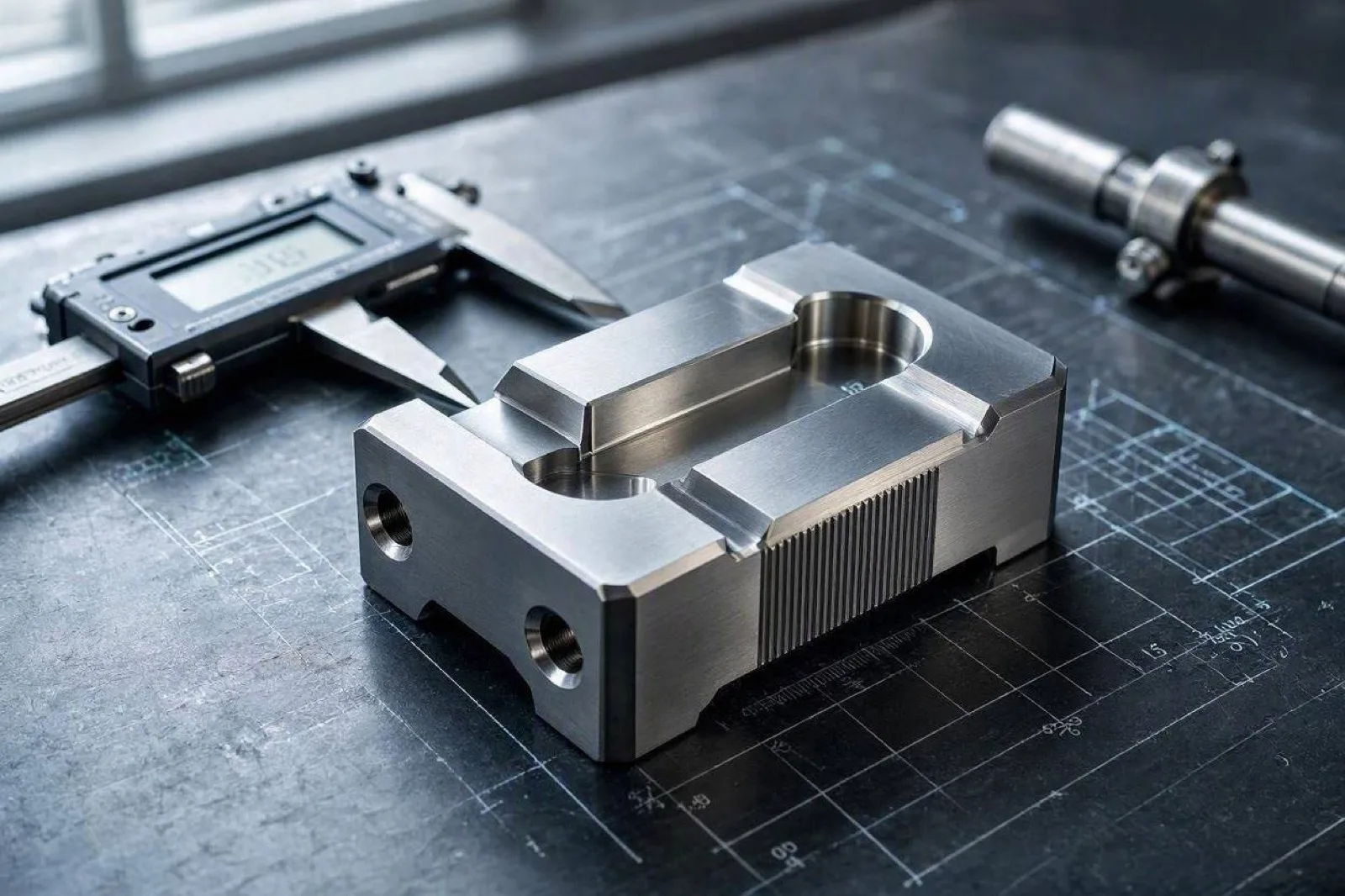
With CNC, machine time is the main driver, and it increases with the volume of material that needs to be removed (the difference between the blank and the finished part) and with how easily that can be done. Deep pockets, slender tools, hard materials, and fine surfaces = slower feed rates = more hours. The second major factor is the number of setups: every time a part is turned over to machine another side, it requires a new alignment and a new setup—expect an additional 30–60% for each additional side.
- Volume of material removed — large block, small part = a lot of "empty" milling
- Number of setups / sides — 3-axis parts machined on one side are the least expensive; 5-axis or more setups increase the cost
- Material and Machinability — 6082 aluminum can be machined many times faster than stainless steel or titanium
- Tolerances and Roughness — see DFM: Tight tolerances and low Ra values add finishing passes and inspection
- Holes, threads, depths—every special tool and changeover adds time
03
Sheet metal: material + cut length + number of bends
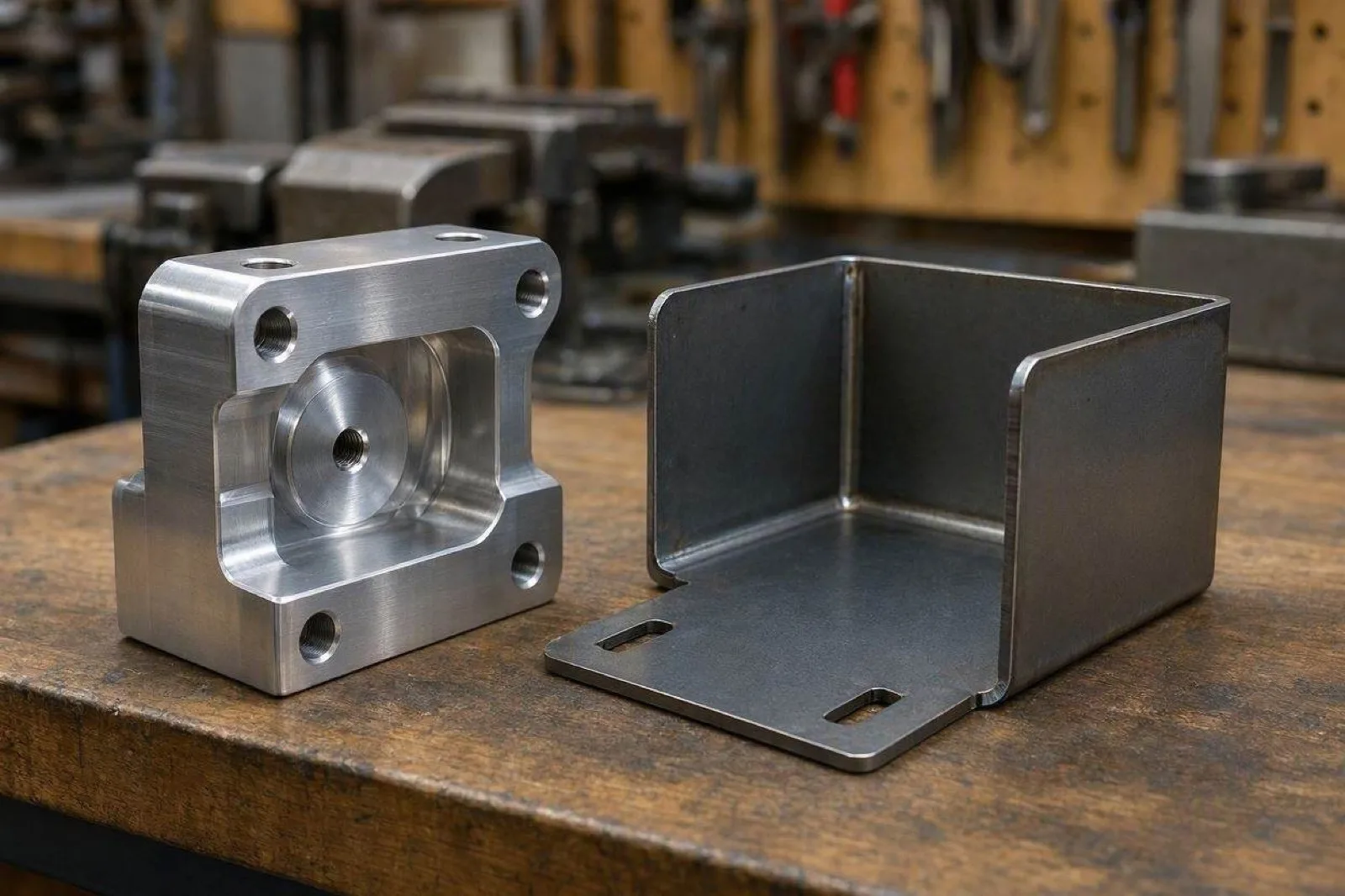
The sheet metal price is composed quite transparently of three parts. Material = developed area × thickness × price per kg of the given sheet metal. Cutting = cut length (perimeter + cutouts) × laser rate, plus the number of laser passes (each laser pass takes time). Bending = number of bends × time per bend on the press brake, plus tool setup. On top of that comes the surface treatment (powder coating, wet paint, galvanizing), which typically adds 15–40%.
That’s why, when working with sheet metal, you can lower the price using different strategies than with CNC: fewer bends, fewer different radii (less press retooling), fewer separate cutouts, and a reasonable thickness. A part designed to be cut and bent “in a single operation” is significantly cheaper than one that requires five setups.
04
3D Printing: Volume, Time, and Technology Chosen
With 3D printing (and this is exactly the part that goes into the calculation), you pay for the material used, machine time, and post-processing—and the ratio between them varies depending on the technology. With FDM and SLA, the price increases mainly with the part’s volume and height (number of layers × time per layer), plus the cost of supports—both the material and their subsequent removal. With MJF/SLS (powder-based technologies), the price depends on the part’s volume and how well the parts “pack” into the build, since you’re charged for the volume of the chamber used.
- The volume of the part's material (and, for SLA/FDM, the volume of the supports as well) — the main material component
- Height / Number of Layers — A shorter, strategically oriented part prints faster
- Technology: FDM (most affordable, functional prototypes) < SLA (detail, smooth surface) < MJF/SLS (production runs, no supports, strong parts)
- Post-processing — removal of support structures, sandblasting, painting; for SLA, also washing and post-curing
- Batch Filling — For powder-based processes, more parts in the chamber = lower price per unit
// WHAT DRIVES THE PRICE THE MOST, BASED ON TECHNOLOGY
METRICTECHNOLOGIEMAIN DRIVER
CNC Machiningspindle timeVolume removed + number of clamping operations
Sheet metalcut + bendcut length, burn-throughs, number of bends
FDM / SLAtime + materialsheight of the component + supports
MJF / SLSchamber volumePart volume + batch fill volume
05
Leverage: What Drives Down the Price of Anything
Across all technologies, there are several universal rules. Volume offsets one-time costs—the most expensive leap is from 1 to several units. Tolerances and surface finish: specify them selectively, not across the board. Material: standard and stock materials are cheaper than exotic or custom-cut ones. And delivery time—express delivery is a legitimate service, but it comes with a surcharge (easily 20–50%); if you’re not in a hurry, the standard delivery time is the cheapest option.
You can estimate the cost of a simple part with a few holes and two bends on paper. However, once you start combining technologies, series, and surface finishes, only a system-based calculation using the manufacturer’s actual rates will give you a reliable figure.
06
When to Calculate by Hand and When to Let the System Do It
A rough estimate based on the factors listed above is a great way to get a sense of the order of magnitude of the price and rule out nonsense (and inflated quotes). But to get an exact figure, you need a specific manufacturer’s actual rates, current material prices, and machining time calculated from the geometry—you can’t do that manually, especially for complex parts and different production runs. This is exactly what Chainly does for shops: it measures the key parameters from the model (volume, surface areas, holes, cut length, bends) and combines them with that shop's own rates. The quote you get from the shop is then based on real numbers, not an estimate.
#price#costing#CNC#sheetmetal#3Dprinting#series